

















• EarlyGame PLUS top logo
  • Join to get exclusive perks & news!
English
    • News
    • Guides
    • Gaming
      • Codes
      • League of Legends
    • Creators
    • Entertainment
    • Careers
    • EarlyGame+
  • Login
  • Homepage My List Settings Sign out
  • News
  • Guides
  • Gaming
    • All Gaming
    • Codes
    • League of Legends
  • Creators
  • Entertainment
  • Careers
  • EarlyGame+
Game selection
Kena
Gaming new
Enterianment CB
ENT new
Influencer 5229646 640
TV Shows Movies Image
TV shows Movies logo 2
Fifa stadium
Fc24
Fortnite Llama WP
Fortnite Early Game
LOL 320
Lo L Logo
Codes bg image
Codes logo
Smartphonemobile
Mobile Logo
Videos WP
Untitled 1
Cod 320
Co D logo
Rocket League
Rocket League Text
Apex 320
AP Ex Legends Logo
DALL E 2024 09 17 17 03 06 A vibrant collage image that showcases various art styles from different video games all colliding together in a dynamic composition Include element
Logo
Logo copy
GALLERIES 17 09 2024
News 320 jinx
News logo
More EarlyGame
Esports arena

Polls

Razer blackhsark v2 review im test

Giveaways

Rocket league videos

Videos

Valorant Tournament

Events

  • Copyright 2026 © eSports Media GmbH®
  • Privacy Policy
  • Impressum and Disclaimer
 Logo
English
  • English
  • German
  • Spanish
  • EarlyGame india
  • Homepage
  • Gaming

The 50 Best Games With An Amazing Story

1-50

Ignacio Weil Ignacio Weil
Gaming - April 16th 2026, 17:00 GMT+2
Disco Elysium cropped processed by imagy

Disco Elysium (2019)

What starts as a murder investigation quickly turns into something far messier, funnier, and more painful than a standard detective story. The city feels exhausted, every conversation carries old damage, and even your own thoughts argue like people trapped in the same room. Somewhere in the middle of all that wreckage, Disco Elysium finds space for political bitterness, genuine tenderness, and some of the sharpest writing ever put in an RPG. It does not chase emotional beats with cheap tricks, because it trusts language, mood, and character to do the heavy lifting. Few games have been this interested in failure and still come out feeling this alive. | © ZA/UM

Red dead redemption 2

Red Dead Redemption 1 & 2 (2010-2018)

Outlaw stories usually sell freedom first and tragedy second, but these two understand that the tragedy is the point. The gang in the prequel feels loud, intimate, vain, loyal, and rotten in exactly the way it needs to, which makes every crack in that family hurt more than expected. Then Red Dead Redemption comes in like the bill for everything that happened before it, dragging John Marston toward a future that never had much mercy in it. The writing is patient enough to let campsites, rides, and half-finished conversations do as much work as the gunfights. Put together, they play like one long funeral for a way of life that was already dying when the story began. | © Rockstar Games

Clair obscur expedition 33

Clair Obscur: Expedition 33 (2025)

The setup is immediately cruel: every year, a divine figure erases an entire age from existence, and another group walks toward near-certain death hoping to stop her. That premise could have carried the whole thing on atmosphere alone, but the real strength here is how much feeling the cast brings into a world already drowning in beauty and grief. There is a constant sense that everyone is moving under the shadow of a deadline they cannot outrun, which gives even quieter scenes real pressure. It helps that the art direction never feels detached from the emotions driving the story. All of that is why Clair Obscur: Expedition 33 lands as more than just another stylish fantasy RPG. | © Sandfall Interactive

DEATH STRANDING

Death Stranding (2019)

Almost nobody would pitch parcel delivery across a ruined America as one of the best narrative hooks of its generation, and yet the story works because it leans fully into loneliness instead of trying to decorate it away. Sam is not written as an effortless savior, but as a man who looks emotionally sealed shut even when the world keeps asking more from him. The strange terminology, ghostly imagery, and apocalyptic lore could have buried the human side, but they never quite do. The emotional core stays clear the whole time: grief isolates, connection hurts, and survival without other people is barely survival at all. Death Stranding turns that idea into something much sadder and more sincere than its oddest trailers ever suggested. | © Kojima Productions

God of war

God of War (2005)

For a series built on rage, this saga became surprisingly good at writing the aftermath of it. Once God of War stopped treating Kratos as a force of destruction and started treating him as a man forced to live with himself, the character opened up in a huge way. The older games gave the franchise its scale and fury, but the later chapters gave it bruises, restraint, and a father-son dynamic strong enough to reframe everything that came before. That shift never felt like a betrayal of the original identity, which is part of the achievement. Very few long-running series manage to mature their lead this convincingly without sanding off what made him memorable in the first place. | © Santa Monica Studio

Alan Wake

Alan Wake (2010)

What Alan Wake gets right is the feeling that the story itself has turned predatory. Bright Falls never behaves like a normal setting, and that warped reality makes every page, broadcast, and late-night encounter feel like part of a trap that already knows the ending. The game’s mix of pulp, television melodrama, and psychological horror could have turned silly in a hurry, but the tension holds because the central panic is so readable. A writer losing control of his own narrative is a strong fear to build around, and Remedy squeezes it for all it is worth. Even with all the weirdness, the story always knows exactly where the dread is coming from. | © Remedy Entertainment

Ghost of Tsushima

Ghost of Tsushima (2020)

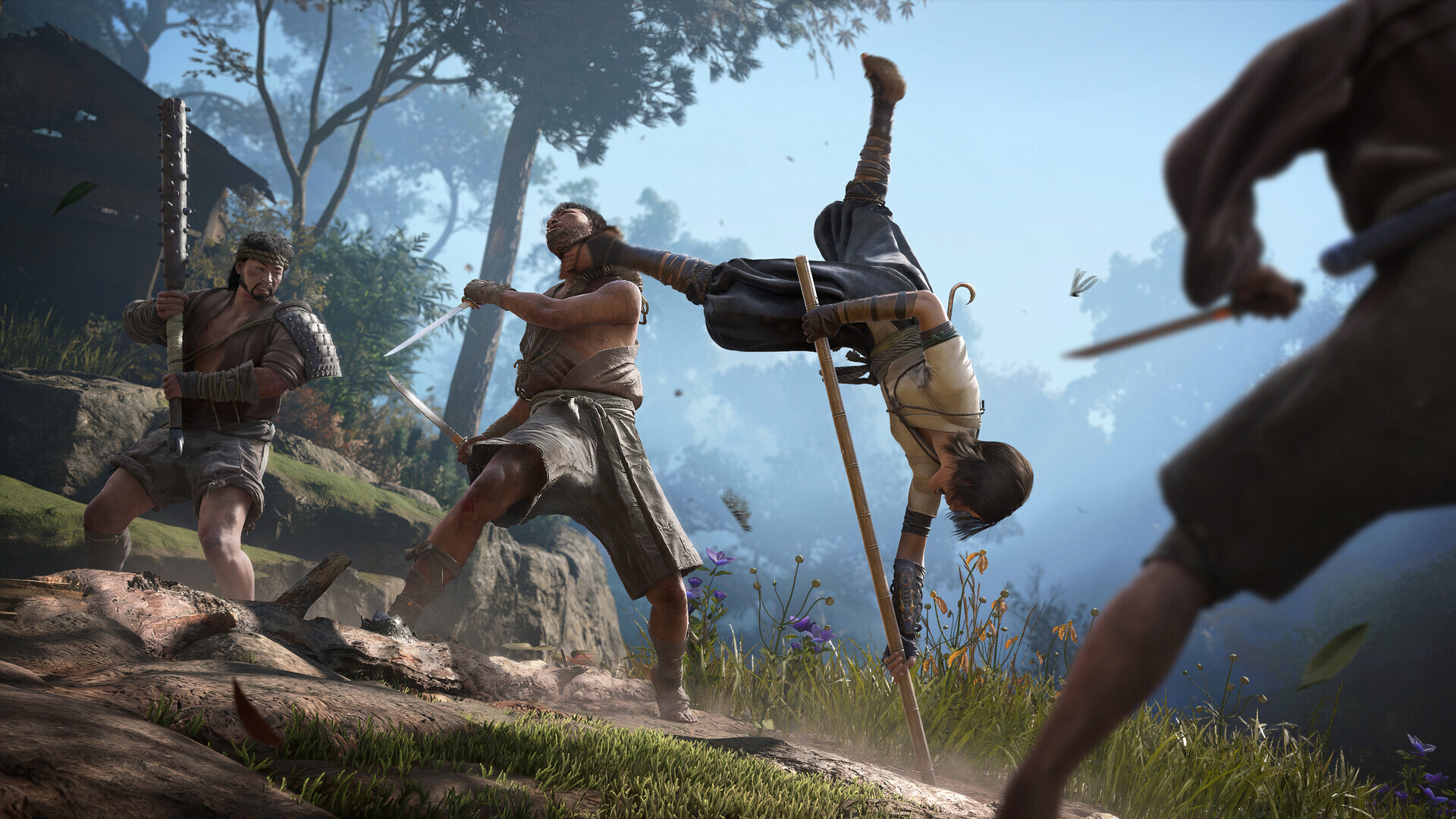
This story works because it understands that transformation is not inspiring when it comes cheap. Jin begins with a clear code, a noble inheritance, and a pretty stable sense of who he is supposed to be, then spends the rest of the journey paying for every step away from that version of himself. By the time Ghost of Tsushima really settles into its best material, the war has become personal in ways that go far beyond defeating invaders and saving villages. Family history, pride, shame, and the burden of becoming a symbol all start pressing on the same wound. That is what gives the game its dramatic weight long after the sword fights stop being new. | © Sucker Punch Productions

Sleeping Dogs

Sleeping Dogs (2012)

The action is slick, the city is gorgeous at night, and the undercover-cop setup looks familiar enough on paper. What gives the story real edge is how unstable Wei becomes once loyalty stops being a clean professional line and starts turning into something emotional, messy, and self-destructive. Everyone around him seems to demand a different performance, and the tension comes from watching those performances grind against each other until something gives. That is where Sleeping Dogs separates itself from the usual crime sandbox, because the conflict never feels purely external. It knows that a double life only stays exciting for so long before it starts rotting the person living it. | © United Front Games

Shenmue

Shenmue (1999)

Revenge stories are usually built to keep moving, which is exactly why this one feels so unusual. The game slows itself down with errands, conversations, weather changes, jobs, and long stretches of asking around, and somehow that patience makes the loss at its center feel heavier instead of lighter. Yokosuka has enough routine in it that grief starts feeling physical, like it has settled into the streets rather than staying locked inside one cutscene. There is very little desperation to impress you from moment to moment, and that confidence matters. The reason people still remember the mood so vividly is that Shenmue lets mourning unfold at human speed. | © Sega

Cropped The Last of Us

The Last of Us (2013)

Plenty of post-apocalyptic games know how to build ruined cities and ugly survival choices, but far fewer know how to build a relationship players will keep arguing about for years. The genius here is that the emotional core never depends on nobility, because the bond at the center is protective, selfish, loving, and damaging all at once. That tension is what keeps the story from sliding into prestige-drama emptiness. Once The Last of Us reaches its most decisive moments, it stops asking what is morally correct and starts asking what love looks like after the world has stripped away everything clean about it. The answer is not comforting, which is exactly why it stuck. | © Naughty Dog

Final Fantasy

Final Fantasy (1987)

One of the reasons this series has lasted so long is that it never boxed itself into one emotional register. Final Fantasy can be romantic, tragic, political, mystical, intimate, or openly ridiculous depending on the entry, and yet the best games still feel like part of the same storytelling tradition. The worlds are usually huge, but the strongest chapters understand that scale means very little without sacrifice, longing, and character drama pushing underneath it. That is why so many of these stories survive the hardware they were built for. Even when the technology ages, the heartbreak, idealism, and sense of myth tend to stay right where players left them. | © Square Enix

The Witcher

The Witcher (2007)

Fantasy stories love clean moral lines until politics enters the room and ruins them. What makes this series so durable is the way it lets monsters, rulers, rebels, lovers, and ordinary civilians all make enough sense to complicate any easy answer. By the time The Witcher is really firing, Geralt feels less like a chosen savior and more like a tired professional wandering through disasters that were already in motion before he arrived. That gives the world a lived-in bitterness most fantasy RPGs never quite reach. The best quests do not just ask what choice is right; they ask which damage you are willing to live with afterward. | © CD Projekt Red

Mass Effect

Mass Effect (2007)

Big galactic stakes are easy to sell when you have starships, ancient machines, and the end of civilization on the table. The harder part is making players care just as much about a conversation in a corridor as they do about the fate of entire worlds, and that is where the trilogy earns its reputation. The crew never feels like background decoration around Shepard, because everyone brings history, doubt, chemistry, and friction that keeps the Normandy from becoming just another hub menu with good music. The scale keeps expanding, but the writing never forgets where the attachment really forms. That is why people remember the universe, but they miss Mass Effect. | © BioWare

Fallout

Fallout (1997)

The wasteland would be less interesting if it were only about rubble and mutants. What keeps Fallout compelling is the way every region turns into an argument about what kind of society grows back after civilization humiliates itself. Sometimes the answer is absurd, sometimes ugly, sometimes weirdly hopeful, and the series is at its best when all three are sitting in the same room. That retro-future identity gives it style, but the real hook is ideological rot dressed up as worldbuilding. Under the jokes, radio songs, and wasteland scavenging, there is usually a story about people rebuilding the same human mess with different costumes. | © Bethesda

Dragon Age

Dragon Age (2009)

In Dragon Age, the lore only matters because it keeps colliding with power. Mages, templars, nobles, elves, the Chantry, old empires, new fears, and personal ambition all keep pushing against each other until even private conversations start sounding like political events. That gives the series a natural supply of tension before a single demon shows up or a world-ending threat takes shape. It also helps that the companions usually arrive with real convictions instead of just side-quest energy. The setting feels alive because everyone has a different idea of what order, justice, and survival are supposed to cost. | © BioWare

Nie R Automata

NieR: Automata (2017)

A lot of games flirt with existential ideas and then lose interest the moment combat or spectacle needs to take over. NieR: Automata goes the other way, folding repetition, perspective shifts, and structural surprises directly into what it wants to say about consciousness, purpose, and grief. The ruined world matters, the android war matters, and the machines matter, but the story really comes alive when it starts tearing into the emptiness of inherited missions and borrowed identities. It manages to be stylish without turning shallow, which is rarer than it should be. By the end, the game feels less like it told one story than like it kept reopening the same wound from different angles. | © PlatinumGames

Persona 5

Persona (1996)

Teenage routine rarely gets treated as something structurally important in RPG storytelling, which is why this series carved out such a distinct lane for itself. School days, social links, free time, exams, and the pressure of deciding who matters to you are not side decorations here; they are the engine. That design choice gives the cast a closeness many larger-scale adventures never achieve, because the downtime is doing as much narrative work as the supernatural crisis. There is always something fragile underneath the style, whether it is loneliness, performance, repression, or the fear of being seen clearly. That is why Persona stories hit so cleanly when they decide to get serious. | © Atlus

Baldurs Gate 3

Baldur’s Gate 3 (2023)

Freedom is the flashy part, but the real trick is how often that freedom still serves character. Once Baldur’s Gate 3 gets its hooks in, the parasite plot stops being the only thing pulling you forward because the companions start carrying equal dramatic weight. Their damage, pride, faith, appetites, resentment, and vulnerability keep changing the tone of the adventure in ways that feel authored instead of random. The writing can be cruel, romantic, funny, intimate, or openly theatrical without losing control of itself. That range is a huge part of why the story feels so substantial instead of just reactive. | © Larian Studios

Chrono Trigger

Chrono Trigger (1995)

Time travel can become a mess very quickly when a story falls in love with its own cleverness. This one stays graceful because it keeps the pacing tight, the emotions readable, and the sense of adventure moving even when the stakes become enormous. The cast is easy to care about almost immediately, and the different eras never feel like gimmick stops on a tour. When Chrono Trigger shifts from cheerful momentum into melancholy, especially around its darker futures, the contrast only makes the world feel richer. That balance between warmth, urgency, and wonder is why it still feels fresher than plenty of RPGs released decades later. | © Square Enix

Knights of the Old Republic

Star Wars: Knights Of The Old Republic 1 & 2 (2003-2004)

The first game understands how to deliver myth on a massive scale, and the second understands how to interrogate that myth until it starts looking unstable. Together, the Knights of the Old Republic games show how much richer Star Wars becomes when heroism, ideology, and the Force stop being treated as simple binaries. One entry is smoother, cleaner, and built around one of gaming’s most famous reveals. The other is darker, rougher, and far more interested in doubt, manipulation, and the damage belief can do. That contrast is exactly why the pair still feels so important in conversations about story-driven RPGs. | © BioWare

Divinity

Divinity: Original Sin 1 & 2 (2014-2017)

These games never had trouble giving players room to experiment, but what makes them memorable is that the story keeps up with that freedom instead of getting flattened by it. The first entry has a lively, adventurous energy, while the sequel pushes harder into ambition, power, and the consequences of becoming something larger than a person should be. Party dynamics matter, worldbuilding matters, and choice rarely feels like a cosmetic feature pasted over a fixed outcome. By the time the second game settles into its bigger ideas, it has already earned them through character tension and real narrative momentum. That is why Divinity: Original Sin and its sequel feel like more than just excellent systems-driven RPGs. | © Larian Studios

Arcanum

Arcanum: Of Steamworks and Magick Obscura (2001)

Fantasy settings often borrow the look of industrial change without caring much about what that change does to people. Here, the friction between invention and magic shapes the entire world, so class, prejudice, modernization, and power struggles all come baked into the setting rather than sprinkled on top of it. By the time Arcanum: Of Steamworks and Magick Obscura reveals how much larger its conspiracy really is, the social tension underneath everything has already done half the storytelling work. That gives the plot extra bite even when the game shows its age around the edges. It remains one of the clearest examples of worldbuilding carrying genuine thematic weight through an RPG. | © Troika Games

Planescape Torment

Planescape: Torment (1999)

Most RPGs want to know how you will save the world. This one is much more interested in whether a person can survive the weight of their own history once memory starts breaking apart. The setting is strange enough to be unforgettable, but the weirdness never feels like decoration for its own sake because everything bends back toward identity, guilt, and transformation. The questions it asks are philosophical, yet the writing never lets them drift away from pain and consequence. That is why the game still feels so singular after all these years. Very few stories in the genre cut this deep the way Planescape: Torment does. | © Black Isle Studios

The Banner Saga

The Banner Saga (2014)

The end of the world is usually sold as spectacle, but this game treats it like exhaustion. Supplies run low, tempers fray, every decision seems to punish someone, and the caravan structure keeps the pressure constant because there is no real place to exhale. By the time The Banner Saga settles into its harshest stretches, survival already feels heavy enough that heroism becomes almost secondary. The Norse-inspired setting gives the journey grandeur, but the human weariness underneath it is what gives the story its grip. It is one of the few fantasy games that makes despair feel logistical before it ever makes it feel mythic. | © Stoic

Skies of Arcadia

Skies of Arcadia (2000)

Adventure can feel childish in the wrong hands, but Skies of Arcadia never makes that mistake. Its optimism has conviction behind it, which lets the story chase discovery, friendship, and sky-pirate wonder without draining the danger out of the world. The empire is still a threat, the larger mysteries still matter, and the stakes rise in satisfying ways, yet the game never becomes embarrassed by its own sense of awe. That sincerity is a big part of the charm. It understands that wonder is not a weakness in storytelling when the characters are strong enough to carry it honestly. | © Sega

Wolfenstein The New Order

Wolfenstein: The New Order (2014)

What makes this story work is not just the alternate-history premise, but the way it gives its lead room to feel worn down by it. BJ is still brutal when he needs to be, yet the writing lets tenderness, exhaustion, and guilt sit beside the violence without turning him into a different character entirely. The resistance around him also matters, because those relationships keep the larger conflict from becoming just another series of missions. By the time Wolfenstein: The New Order settles into its strongest beats, it has already proven it wants more than pulp catharsis. That extra emotional weight gives the whole thing more staying power than most shooters in its lane. | © MachineGames

Legacy of Kain

Legacy of Kain (1996)

No other dark fantasy series in games sounds quite this confident in its own voice. The dialogue is rich with venom, prophecy, regret, and theatrical grandeur, but it never feels empty because the world underneath it is just as damaged as the people speaking. Empires are already collapsing, loyalties are always rotting, and power never arrives without some larger curse attached to it. Somewhere inside all that fatalism, Legacy of Kain builds a story that feels operatic without losing its bite. That mix of language, atmosphere, and tragedy is why the series still stands apart. | © Crystal Dynamics

Spec Ops

Spec Ops: The Line (2012)

Military games spent years pretending war was mostly about momentum, grit, and the satisfaction of pushing forward. This one walks into that tradition looking familiar, then starts poisoning it from the inside. Dubai becomes less a battlefield than a psychological trap, and the further the squad goes, the less stable any idea of heroism begins to look. There is nothing casual about the way Spec Ops: The Line dismantles the fantasy it first appears to be selling. By the end, the violence feels less like achievement than indictment. | © Yager Development

Bioshock

BioShock (2007)

Rapture is one of those settings that does half the storytelling work before a character even opens their mouth. Every flooded corridor, every collapsing ideal, and every leftover piece of propaganda keeps reinforcing the same central idea: a society built on ego was always going to tear itself apart eventually. That is why the city never feels like a cool backdrop with lore taped onto it later. In the middle of all that decay, BioShock turns philosophy, control, and personal agency into something far more dramatic than a standard shooter plot. It remains one of the clearest cases of worldbuilding and narrative landing the same hit together. | © Irrational Games

Metal Gear Solid

Metal Gear Solid (1998)

Absurdity and seriousness are constantly wrestling inside this franchise, and somehow that tension is exactly what makes it memorable. Nuclear fear, genetic legacy, political manipulation, information warfare, and larger-than-life personalities all get thrown together with absolute conviction, so even the strangest turns still feel authored rather than random. The series never sounds embarrassed by its own excess, which is a huge part of its identity. Once Metal Gear Solid starts firing on all cylinders, it becomes one of gaming’s most unusual blends of blockbuster chaos and thematic ambition. Very few franchises have ever sounded this eccentric while aiming this high. | © Konami

Deus Ex

Deus Ex (2000)

Conspiracy stories tend to get weaker the more they explain themselves, but this one keeps gaining force as its layers peel back. Secret agendas, corporate power, surveillance, augmentation, and institutional rot all belong to the same atmosphere, which keeps the world from feeling like a pile of cool ideas stacked without discipline. The personal decisions matter because the systems around them matter too. Somewhere in that tension, Deus Ex becomes more than a cyberpunk thriller and starts reading like a broader argument about control. That is why it still feels sharp long after so many imitators borrowed its surface. | © Ion Storm

Silent Hill 2

Silent Hill (1999)

The monsters matter, but they are rarely the real source of the dread. What gives the series its reputation is the way guilt, grief, repression, and private damage keep bleeding into the landscape until the setting feels like a hostile state of mind rather than a town. The fog and rust are iconic, of course, yet the deeper strength is how personal the horror becomes once the story settles in. By the time Silent Hill reaches its best material, it is no longer asking what is hiding in the dark so much as what part of the self refuses to stay buried. That is a much harder fear to shake off. | © Konami

Pathologic 2

Pathologic (2005)

Comfort is not part of the design here, and that choice gives the story much of its power. The town feels diseased in body, language, and ritual long before the plague fully consumes it, so every day carries the sense that collapse is already underway and nobody can really stop it cleanly. Survival does not arrive in heroic form, and even the most necessary decisions feel contaminated by compromise. Very few games use exhaustion and confusion this deliberately, which is why Pathologic remains so singular. It turns dread into structure instead of treating it like decoration. | © Ice-Pick Lodge

Lobotomy Corporation

Lobotomy Corporation (2018)

At first, the management structure almost suggests a detached kind of storytelling, like everything important will stay buried under systems and routine. Then the routines start revealing how much suffering has been built into them, and the sterile surface begins to look like a mask stretched over something deeply broken. Bureaucracy, repetition, fear, and exploitation all feed the same nightmare logic here. Somewhere in that machinery, Lobotomy Corporation turns administration itself into a form of horror. That is what gives it such an unpleasant and unforgettable edge. | © Project Moon

SOMA

SOMA (2015)

The underwater horror is effective, but the part that really lasts is philosophical rather than visceral. Identity becomes unstable in a way the game refuses to simplify, and that refusal is what gives the story such a cold, lasting sting. Every new revelation pushes harder on the idea that continuity may be far less comforting than people want it to be. Once SOMA reaches its bleakest conclusions, the emotional force comes from how inevitable they feel rather than how loudly they are delivered. It knows exactly how to let a realization sink in and do its damage slowly. | © Frictional Games

Undertale

Undertale (2015)

What looks light at first slowly reveals a very different kind of confidence underneath. The humor is sharp, the sentiment is real, and the writing is clever enough to make the player’s habits feel like part of the narrative rather than something happening outside it. That is a difficult balance to maintain, especially in a game so willing to shift from absurdity to sincerity without warning. Once Undertale starts showing how much it remembers, the relationship between player and story changes in a way that still feels unusual. It earned its meta reputation by actually building emotion into the trick. | © Toby Fox

Decarnation

Decarnation (2023)

The supernatural imagery lands because the emotional unraveling beneath it is already disturbing on its own. Body anxiety, humiliation, artistic collapse, and the pressure of existing as an object for other people’s expectations give the story a private ugliness before the nightmare elements fully take over. The surreal descent would not matter nearly as much without that foundation. In the middle of all the blood, mirrors, and fractured identity, Decarnation stays focused on what it means to become unusable to the world that once demanded a performance from you. That makes the horror feel more intimate than decorative. | © Atelier QDB

Outer Wilds

Outer Wilds (2019)

Curiosity is the real engine, which is a risk very few games could pull off this well. Instead of forcing drama through constant conflict, the story trusts discovery, pattern recognition, and quiet accumulation to create its emotional shape. Planet by planet, clue by clue, the world opens into something that feels both grand and fragile. What makes Outer Wilds so affecting is that the mystery never exists only to be solved. It becomes a meditation on endings, scale, and acceptance without ever needing to spell that out too neatly. | © Mobius Digital

Hades

Hades (2020)

Repetition usually has to justify itself narratively, and this game handles that challenge better than almost anyone. Every failed attempt adds more history to the household, more friction to the family, and more texture to relationships that could have stayed mythic and distant in a weaker script. The dialogue helps enormously, because nobody feels like a static symbol waiting around to explain lore. By the time Hades reaches its strongest character work, the escape loop has become inseparable from the emotional arc. That is why the story never feels like something pasted on top of the action. | © Supergiant Games

Firewatch

Firewatch (2016)

The landscape is beautiful, but the story is much less interested in beauty than in what people do with distance. A voice over a radio becomes companionship, projection, flirtation, and escape all at once, which lets the emotional tension build in a way that feels recognizably human rather than melodramatic. Henry is not navigating epic stakes; he is navigating himself badly. That is where Firewatch finds its real dramatic pull. It understands how easily loneliness can turn another person into a place to hide. | © Campo Santo

The Forgotten City

The Forgotten City (2021)

Time loops can start feeling mechanical very quickly if the world inside them is not strong enough to support repetition. This one avoids that problem by making each reset clarify the city’s moral pressure instead of draining it away. Law, fear, self-preservation, and philosophical disagreement all keep pressing against one another until even casual conversations feel loaded. Somewhere inside that structure, The Forgotten City becomes more than a clever mystery and starts reading like a debate staged under impossible rules. That gives the story more bite than the premise alone would suggest. | © Modern Storyteller

What Remains of Edith Finch

What Remains of Edith Finch (2017)

This family history is built out of separate stories, yet none of them feel interchangeable. Each death has its own form, its own emotional logic, and its own way of showing how grief gets shaped into legend when a family lives beside it for long enough. That variety keeps the structure lively while the framing narrative keeps everything tied to the same inheritance of sorrow. In the middle of all that, What Remains of Edith Finch becomes a story about how people narrate tragedy simply to keep it livable. It is one of the strongest examples of interactive storytelling using form as memory. | © Giant Sparrow

To the Moon

To the Moon (2011)

The scale stays small, and that restraint is a huge part of why the story works. Memory is handled with a tenderness that never feels flimsy, even when the game starts revealing just how much pain and meaning can survive inside altered versions of a life. The presentation may be modest, but the emotional rhythm is extremely controlled. By the time To the Moon arrives at its central truth, it has already done all the quiet work needed to make it land. Few games have trusted softness this fully without losing force. | © Freebird Games

Pentiment

Pentiment (2022)

Murder may be the initial hook, but time is the real storyteller here. The setting has enough class tension, religious upheaval, labor, resentment, and daily compromise in it that every accusation feels connected to forces much larger than one single crime. That gives the narrative a density many historical games never reach. As the years pass, Pentiment shifts from mystery into something broader and more ambitious about memory, authorship, and the making of history itself. That larger shape is what gives it such unusual staying power. | © Obsidian Entertainment

Hellblade Senuas Sacrifice

Hellblade: Senua’s Sacrifice (2017)

The journey is intense, but what gives it real force is how completely the experience stays tied to one interior perspective. Fear, devotion, fixation, and pain all move through the same space at once, which makes the world feel less like a setting to conquer than a state of being the player is forced to inhabit. The game never turns that subjectivity into something tidy or distant. Once Hellblade: Senua’s Sacrifice locks into its emotional rhythm, the intimacy becomes almost suffocating. That pressure is a major reason it stays with people. | © Ninja Theory

The Wolf Among Us

The Wolf Among Us (2013)

The fairy-tale noir angle sounds like a pitch that could fall apart in less careful hands. What saves it is the grit in the writing, especially around a lead whose violence never stops shadowing every attempt to act like a better man. The world feels seedy, resentful, and unstable in ways that make the fable material more interesting rather than less grounded. Somewhere inside that pressure, The Wolf Among Us builds a strong dramatic current out of class tension, fear, and the cost of managing rage instead of unleashing it. The mystery matters, but the atmosphere is what really seals it. | © Telltale Games

Portal

Portal 1 & 2 (2007-2011)

Comedy in games often burns hot and disappears fast, which makes this pair all the more impressive. The writing is consistently sharp, but the reason it lasts is that the sterile labs, hidden remnants, and escalating experiments are telling their own story right alongside the jokes. Humor, menace, and absence keep feeding into the same atmosphere rather than fighting each other. When Portal 1 & 2 are at their best, every test chamber feels like a puzzle, a gag, and a warning at the same time. That blend is still remarkably hard to imitate. | © Valve

Double Fine Productions

Grim Fandango (1998)

A noir afterlife full of bureaucracy, folklore, and dead-end jobs is already a great starting point, but the story lasts because it brings real feeling to the style. Manny is exactly the right center for this world: slick enough to move through it, weary enough to expose its sadness, and likable enough to hold together all the detours into comedy and corruption. The writing is clever without sounding desperate to prove it. By the time Grim Fandango fully opens up, its strange land of the dead feels oddly lived in. That is a rare achievement for a story this stylized. | © LucasArts

Danganrompa

Danganronpa (2010)

Style does a lot of the first impression work, but paranoia is what really carries the series. Bright colors, exaggerated personalities, cruel rules, and theatrical class trials create an energy that feels both ridiculous and genuinely tense, because someone in the room is always panicking, lying, or one step away from death. Truth becomes performance, and performance becomes survival. That is where Danganronpa finds its edge. Very few games make distrust feel this loud, flashy, and vicious without losing narrative control. | © Spike Chunsoft

The Stanley Parable

The Stanley Parable (2013)

The office is intentionally dull because the real spectacle is the fight between player behavior and narrative authority. What begins as a dry joke keeps expanding into something funnier, sharper, and nastier the more often you refuse to cooperate with what the story seems to want from you. The narration is crucial, of course, but the deeper strength lies in how well the game understands the habits players bring into interactive fiction. Once The Stanley Parable starts weaponizing those habits, disobedience itself becomes the subject. That is why it still feels fresh rather than merely clever. | © Galactic Cafe

1-50

Not every great game earns its place through mechanics alone. The ones that really last tend to leave behind something messier – a character you cannot shake, a choice that still feels questionable years later, or an ending that lands with the force of a brick.

Across every era, a handful of titles proved that storytelling in games can do far more than fill the gaps between action scenes. These are the ones players remember for the tension, the heartbreak, the payoff, and that rare feeling of sitting through the credits without touching the controller.

  • Facebook X Reddit WhatsApp Copy URL

Not every great game earns its place through mechanics alone. The ones that really last tend to leave behind something messier – a character you cannot shake, a choice that still feels questionable years later, or an ending that lands with the force of a brick.

Across every era, a handful of titles proved that storytelling in games can do far more than fill the gaps between action scenes. These are the ones players remember for the tension, the heartbreak, the payoff, and that rare feeling of sitting through the credits without touching the controller.

Related News

More
Killers of the Flower Moon
Entertainment
15 of Leonardo DiCaprio's Most Iconic Roles in Photos
Scarface The World Is Yours 2006
Gaming
15 Movies That Got a Sequel as a Video Game
Cyberpunk 2077
Gaming
15 Video Games That Had Terrible Launches But Made Brilliant Comebacks
Freddie Got Fingered
TV Shows & Movies
15 Films With Absolutely Zero Flashbacks or Flash-Forwards
Cropped the house that jack built 2018
TV Shows & Movies
15 Most Unique Movies Since 2000
Once Upon a Time in Hollywood
Entertainment
15 of Sydney Sweeney's Most Memorable Roles in Photos
Dead Space
Gaming
15 Horror Games That Are Actually Scary
Jim Carrey
Entertainment
15 Famous Celebrities Who Are Obsessed With Pro Wrestling
The Game 1997
TV Shows & Movies
15 Movies That Will Keep You Hooked From Start To Finish
Deadpool and wolverine hes right behind me
Entertainment
15 Movies That Use the “He’s Right Behind Me, Isn’t He?” Gag
Star Wars The Last Jedi
TV Shows & Movies
15 Movies Made Purely to Push an Agenda
Pirates of the Caribbean Dead Mans Chest 2006 cgi
Entertainment
15 Movies With Old CGI That Still Look Amazing
  • All Gaming
  • Videos
  • News
  • Home

Subscribe to our Newsletter

Sign up for selected EarlyGame highlights, opinions and much more

About Us

Discover the world of esports and video games. Stay up to date with news, opinion, tips, tricks and reviews.
More insights about us? Click here!

Links

  • Affiliate Links
  • Privacy Policy
  • Impressum and Disclaimer
  • Advertising Policy
  • Our Editorial Policy
  • About Us
  • Authors
  • Ownership

Partners

  • Kicker Logo
  • Efg esl logo
  • Euronics logo
  • Porsche logo
  • Razer logo

Charity Partner

  • Laureus sport for good horizontal logo

Games

  • Gaming
  • Entertainment
  • Creators
  • TV Shows & Movies
  • EA FC
  • Fortnite
  • League of Legends
  • Codes
  • Mobile Gaming
  • Videos
  • Call of Duty
  • Rocket League
  • APEX
  • Reviews
  • Galleries
  • News
  • Your Future

Links

  • Affiliate Links
  • Privacy Policy
  • Impressum and Disclaimer
  • Advertising Policy
  • Our Editorial Policy
  • About Us
  • Authors
  • Ownership
  • Copyright 2026 © eSports Media GmbH®
  • Privacy Policy
  • Impressum and Disclaimer
  • Update Privacy Settings
English
English
  • English
  • German
  • Spanish
  • EarlyGame india