









































A person who thought far beyond the limits of his body and the universe we know.
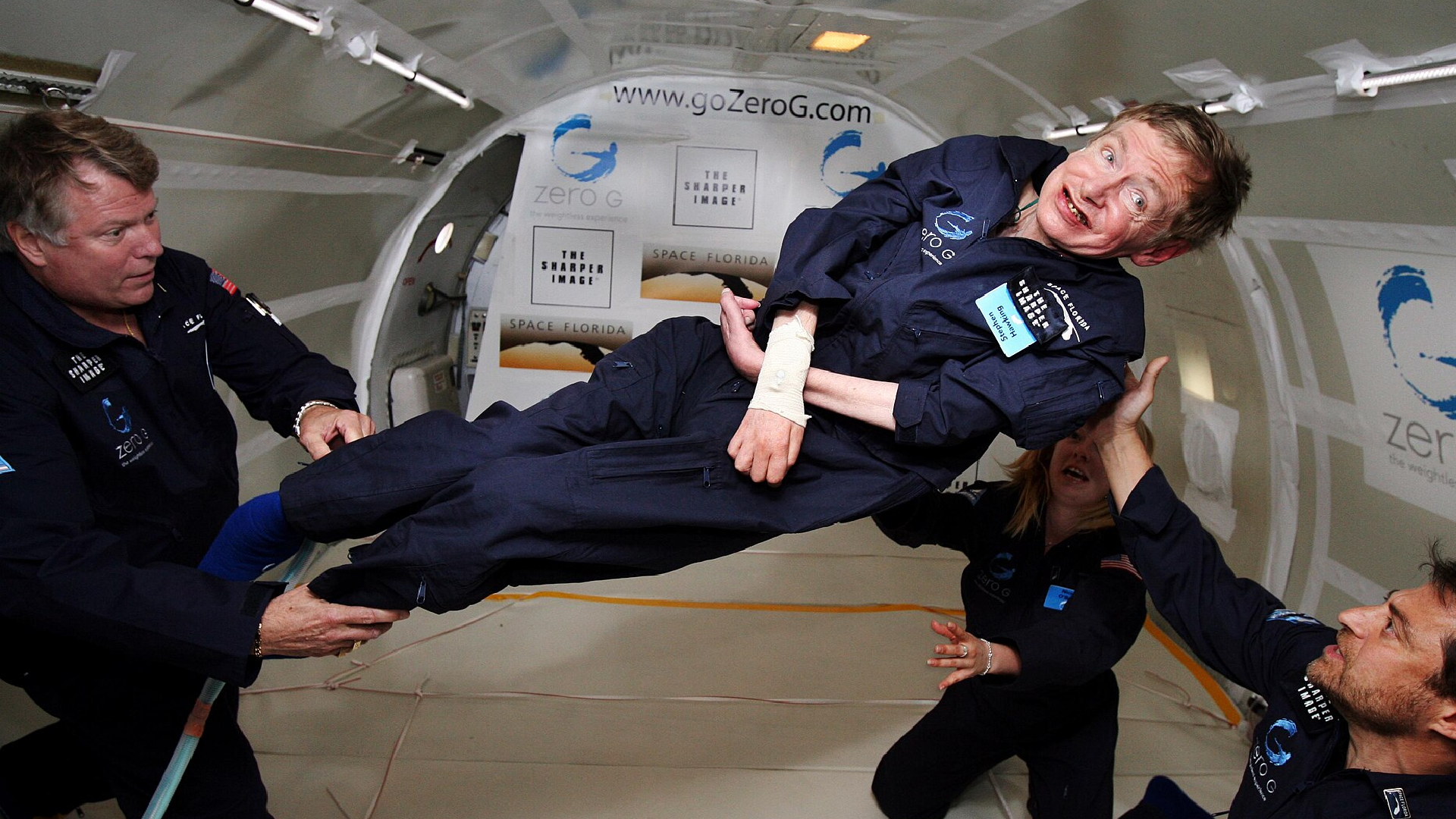
On this day, March 14, the scientific world not only commemorates one of the most significant physicists of the 20th and early 21st centuries, but also an extraordinary personality: Stephen Hawking. Born on January 8, 1942, in Oxford, he would have turned 84 this year. His date of death coincidentally falls on Albert Einstein’s birthday – a symbolic coincidence for a man who profoundly changed our understanding of the universe.
A Brilliant Mind Against the Limits of the Body
Stephen William Hawking showed exceptional mathematical and physical talent early on, yet he was by no means considered a classic model student. It was only during his studies in Oxford and later in Cambridge that his scientific abilities fully unfolded.
At just 21 years old, Hawking was diagnosed with ALS (amyotrophic lateral sclerosis), an incurable neurological disease. At the time, doctors gave him only a few years to live. But Hawking defied all predictions: for more than five decades he continued working, eventually communicating through a speech computer and becoming perhaps the most famous scientist of the modern era.
His physical limitations made him a global symbol of human determination – yet Hawking himself rejected being reduced to his illness. What mattered, he said, was the power of thought alone.
Revolutionary Contributions to Cosmology
Hawking’s scientific work fundamentally changed modern physics. Together with Roger Penrose, he demonstrated that Einstein’s general theory of relativity inevitably predicts singularities – points in the universe where space and time collapse.
His most famous achievement, however, is the theoretical prediction of so-called Hawking radiation: black holes are not completely “black,” but lose energy and can eventually evaporate. This idea connected quantum mechanics, thermodynamics, and gravity – three fundamental areas of physics – for the first time.
To this day, the issue remains one of the central open questions of fundamental research: how can a complete theory of quantum gravity be formulated?
With his bestseller A Brief History of Time , Hawking also achieved something rare: he turned highly complex cosmology into a global success and introduced millions of people to modern physics for the first time.
Hawking became well known far beyond academic circles. Appearances in television series, documentaries, and public debates turned him into a cultural icon. He embodied the scientist as a public figure – humorous, approachable, and highly present in the media.
At the same time, he used his fame to warn about global risks: climate change, uncontrolled artificial intelligence, nuclear weapons, and pandemic threats were among his recurring concerns.
Criticism and Controversial Discussions
Like many prominent public figures, Hawking was not free from criticism. Scientifically, he was occasionally accused of focusing more on popular science in his later work than on groundbreaking theoretical research. Some colleagues believed his enormous fame was partly amplified by media attention.
In recent years, it has also been discussed that Hawking’s name appeared in documents related to the convicted sex offender Jeffrey Epstein, which became public during legal proceedings.
These so-called “Epstein Files” mention Hawking in connection with scientific events and meetings in which Epstein participated as a sponsor.
It is important to note that Stephen Hawking was never accused of or charged with any criminal wrongdoing. References relate to contacts within the context of academic events, which at the time were common for many scientists. Nevertheless, his appearance in the documents sparked a broader debate about how scientific institutions deal with private donors and their networks.
A Lasting Legacy
Stephen Hawking left behind more than equations and theories. He changed the public image of science itself: through him, research became part of popular culture, and cosmological questions entered everyday conversations.
His life represents a rare contradiction: extreme physical limitation paired with nearly boundless intellectual freedom. Hawking showed that curiosity and the pursuit of knowledge can be stronger than biological limits.
Or, as he himself once said: "Remember to look up at the stars and not down at your feet."