


























• Lootday.com logo
  • Join today to claim your daily loot
English
    • News
    • Guides
    • Gaming
      • Codes
      • League of Legends
      • Lootday
    • Creators
    • Entertainment
    • Careers
    • Lootday
    • EarlyGame+
  • Login
  • Homepage My List Settings Sign out
  • News
  • Guides
  • Gaming
    • All Gaming
    • Codes
    • League of Legends
    • Lootday
  • Creators
  • Entertainment
  • Careers
  • Lootday
  • EarlyGame+
Game selection
Kena
Gaming new
Enterianment CB
ENT new
Influencer 5229646 640
TV Shows Movies Image
TV shows Movies logo 2
Fifa stadium
Fc24
Fortnite Llama WP
Fortnite Early Game
LOL 320
Lo L Logo
Codes bg image
Codes logo
Smartphonemobile
Mobile Logo
Videos WP
Untitled 1
Cod 320
Co D logo
Rocket League
Rocket League Text
Apex 320
AP Ex Legends Logo
DALL E 2024 09 17 17 03 06 A vibrant collage image that showcases various art styles from different video games all colliding together in a dynamic composition Include element
Logo
Logo copy
GALLERIES 17 09 2024
News 320 jinx
News logo
Lootday bg
Guides
More EarlyGame
Logo copy

Galleries

Lootday bg

lootday

News

News

Codes bg image

Codes

Razer blackhsark v2 review im test

Giveaways

  • Copyright 2026 © eSports Media GmbH®
  • Privacy Policy
  • Impressum and Disclaimer
 Logo
English
  • English
  • German
  • Spanish
  • EarlyGame india
  • Homepage
  • TV Shows & Movies

The 50 Greatest Science Fiction Movies of All Time

1-50

Ignacio Weil Ignacio Weil
TV Shows & Movies - September 23rd 2026, 19:00 GMT+2
Cropped Equilibrium

50. Equilibrium (2002)

Christian Bale shoots his way through a future where emotion has been outlawed, citizens are drugged into obedience, and paintings are treated like contraband. Equilibrium wears its Matrix influence proudly, but the gun-kata combat and Bale’s severe Cleric John Preston give it an identity beyond simple imitation. The politics are hardly subtle, yet that bluntness works for a dystopia literally terrified of people feeling things. Silly? Occasionally. Boring? Never. | © Dimension Films

Cropped Logans Run

49. Logan's Run (1976)

Imagine discovering that turning 30 comes with mandatory execution, except everyone around you insists it is actually a wonderful spiritual ceremony. That nightmare powers Logan’s Run, where Michael York escapes a sealed society obsessed with eternal youth after being ordered to hunt other fugitives. The sets and effects now carry plenty of charming 1970s plastic futurism, but the central idea has aged much better: a comfortable civilization casually discarding anyone who no longer fits its preferred demographic. | © Metro-Goldwyn-Mayer

Cropped A Boy and His Dog

48. A Boy and His Dog (1975)

A teenage Don Johnson crossing a nuclear wasteland with a telepathic dog already sounds like someone lost a bet, and A Boy and His Dog only gets stranger from there. Adapted from Harlan Ellison’s story, its post-apocalyptic future is cruel, grubby, sexually charged, and deeply cynical about humanity rebuilding anything better. The movie can be deliberately unpleasant, particularly through modern eyes, but its nasty humor and scorched-earth weirdness helped establish a flavor of wasteland sci-fi that countless later works would borrow. | © LQ/JAF

Cropped The War of the Worlds

47. The War of the Worlds (1953)

Before alien invasions required skyscrapers collapsing every twelve minutes, The War of the Worlds could terrify audiences with glowing Martian machines quietly floating over the horizon. George Pal’s adaptation relocates H.G. Wells’ story to contemporary America and turns it into lavish Technicolor nightmare fuel, complete with heat rays and humanity discovering how useless its weapons really are. The effects were astonishing for their era, but the helplessness is what keeps the film potent: suddenly, being Earth’s dominant species means absolutely nothing. | © Paramount Pictures

Cropped Upstream Color

46. Upstream Color (2013)

Trying to summarize Upstream Color too neatly almost defeats the purpose. Shane Carruth’s hypnotic sci-fi drama connects parasites, stolen identities, pigs, sound, trauma, and two strangers whose lives seem entangled in ways neither can fully understand. Amy Seimetz and Carruth play the confusion as emotional damage rather than a puzzle waiting for a clever explanation, making the movie unusually intimate for something this abstract. You may finish it with questions, but the mood follows you home before the answers ever do. | © ERBP

Cropped Alphaville

45. Alphaville (1965)

Jean-Luc Godard made a futuristic dystopia without bothering to build the future. Contemporary Paris becomes the cold metropolis of Alphaville, where hard-boiled agent Lemmy Caution encounters a society controlled by the supercomputer Alpha 60 and increasingly stripped of emotion and individual thought. That decision gives the film an eerie timelessness: elevators, glass buildings, fluorescent corridors, and offices suddenly resemble alien architecture. Half noir, half philosophical prank, Alphaville proved science fiction could create another world simply by looking at our own differently. | © Chaumiane Productions

Cropped The Time Travelers Wife

44. The Time Traveler's Wife (2009)

Time travel usually comes with a machine, a mission, or at least some control over the destination. Henry DeTamble gets none of those luxuries. Eric Bana plays a man who involuntarily jumps through different moments of his life, leaving Rachel McAdams’ Clare to build a relationship around unpredictable disappearances and impossible reunions. The science is intentionally soft, because The Time Traveler’s Wife is really interested in what temporal displacement would do to marriage, grief, and ordinary domestic life. Its cruelest villain is simply chronology. | © New Line Cinema

Cropped Predestination

43. Predestination (2014)

Time-travel movies love paradoxes; Predestination looks at the entire paradox rulebook and starts tearing out pages. Ethan Hawke plays a temporal agent pursuing an elusive bomber, but Sarah Snook gradually takes control of the film through a remarkable performance involving identity, fate, and one astonishingly tangled personal history. Based on Robert A. Heinlein’s “All You Zombies,” the story keeps folding back onto itself until cause and effect become almost meaningless. The impressive part is that underneath all that clockwork sits a surprisingly sad human tragedy. | © Blacklab Entertainment

Cropped Tron

42. Tron (1982)

A programmer getting sucked inside a computer sounded fantastical enough when most households did not own one. Tron transformed that premise into glowing arenas, disc battles, digital tyrants, and the light-cycle sequence that permanently lodged itself in pop culture. Jeff Bridges brings welcome looseness to a movie whose technological mythology occasionally takes itself very seriously. The narrative is less sophisticated than its reputation, but visually it was a genuine leap forward, imagining cyberspace years before mainstream culture had any idea how much time we would eventually spend there. | © Walt Disney Productions

Cropped Starship Troopers

41. Starship Troopers (1997)

Audiences expecting straightforward space Marines versus giant insects received exactly that—and a vicious satire hiding inside the recruitment video. Paul Verhoeven presents militarism, propaganda, citizenship, and fascistic spectacle with such a perfectly straight face that plenty of viewers initially missed the joke. Meanwhile, enormous bugs tear attractive young soldiers apart with enthusiastically disgusting regularity. Starship Troopers functions as brainless entertainment and criticism of brainless entertainment simultaneously, which explains why its reputation has grown so dramatically. Would you like to know more? Of course you would. | © TriStar Pictures

Cropped Timecrimes

40. Timecrimes (2007)

Héctor spots something suspicious through binoculars, investigates when every sensible person would stay home, and manages to create an increasingly disastrous time loop. That beautifully simple setup lets Nacho Vigalondo turn Timecrimes into a miniature machine of bad decisions. There are no armies of future soldiers or gigantic temporal portals here, just one ordinary man desperately attempting to repair events while repeatedly making them worse. Its modest scale is exactly why the mechanics work so well; each new complication feels like another screw tightening around him. | © Karbo Vantas Entertainment

Cropped Fifth Element

39. The Fifth Element (1997)

Luc Besson apparently looked at tasteful futuristic minimalism and decided the future needed more orange hair, flying taxis, opera, leopard print, and Gary Oldman wearing whatever that hairstyle is. The result is The Fifth Element, a delirious space adventure starring Bruce Willis as cab driver Korben Dallas and Milla Jovovich as Leeloo, humanity’s unlikely salvation. Its mythology is fairly conventional underneath the neon, but presentation counts for plenty. Two decades of imitators later, the movie still looks like it arrived from a civilization with much more interesting fashion. | © Gaumont

Cropped They Live

38. They Live (1988)

John Carpenter needed sunglasses, aliens, billboards, and professional wrestler Roddy Piper to explain consumer capitalism. Surprisingly, that was enough. In They Live, Piper’s homeless drifter discovers subliminal commands hidden across Los Angeles and realizes society’s wealthy elite are not metaphorically inhuman—they are literally extraterrestrials. Carpenter delivers his politics with the delicacy of a brick through a storefront window, which is precisely part of the charm. Add one gloriously excessive alleyway fistfight and you have sci-fi satire that remains as funny as it is furious. | © Alive Films

Cropped Primer

37. Primer (2004)

Nobody in Primer dramatically announces that they have invented time travel. Two engineers basically discover it while messing around with equipment in a garage, then approach the impossible with exactly the dangerous confidence you would expect from very smart people convinced they can manage everything themselves. Shane Carruth refuses to simplify the technical language or tidy the timeline for viewers, resulting in diagrams, arguments, and headaches that continue long after the credits. Its complexity is notorious, but its real achievement is making time travel feel disturbingly plausible. | © ERBP

Cropped Coherence

36. Coherence (2013)

Eight friends gather for dinner on the night a comet passes overhead. Then the lights go out, another house appears nearby, and casual conversation begins turning into an identity crisis with terrifying mathematical implications. Coherence squeezes multiverse science fiction into an ordinary suburban home, using improvisational performances and barely any spectacle to make reality itself feel unstable. Every character eventually faces the same ugly question: if another version of your life turned out slightly better, how far would you go to steal it? Dinner gets awkward remarkably quickly. | © Bellanova Films

Cropped The Fly

35. The Fly (1986)

Jeff Goldblum’s Seth Brundle initially treats teleportation like the invention that will define his career. A single unnoticed fly makes sure it defines him for much worse reasons. Cronenberg turns the resulting mutation into spectacular body horror—teeth, fingernails, skin and various fluids all become deeply unwelcome—but The Fly hurts because Brundle remains recognizably human while his body abandons him. Geena Davis gives the tragedy its emotional weight. Beneath the famous gore sits a brutal story about disease, deterioration, and loving somebody you cannot save. | © Brooksfilms

Cropped Videodrome 1

34. Videodrome (1983)

Television becomes flesh in David Cronenberg’s Videodrome, and things only get less hygienic from there. James Woods plays sleazy programmer Max Renn, whose search for increasingly extreme broadcasts leads him toward a signal capable of distorting perception and reshaping the human body. VHS technology may have dated, but the movie’s obsession with media altering desire, identity, and reality feels almost indecently modern. Cronenberg did not predict smartphones or social media; he understood something more useful—that people eventually stop knowing where the screen ends and they begin. | © Filmplan International

Cropped The Thing

33. The Thing (1982)

One alien reaches an Antarctic research station, and suddenly being alone with your coworkers becomes even worse than usual. John Carpenter’s masterpiece weaponizes uncertainty: the organism can perfectly imitate another life-form, meaning any person in the room may already have been replaced. Rob Bottin’s practical effects remain jaw-droppingly grotesque, from splitting heads to spider-legged nightmares, yet spectacle never overwhelms the paranoia. Kurt Russell’s MacReady cannot defeat mistrust with a flamethrower. That final uncertainty is exactly why The Thing keeps surviving every generation that discovers it. | © Universal Pictures

Cropped Dark City

32. Dark City (1998)

Every night at midnight, an entire city falls asleep while mysterious figures rearrange its buildings and rewrite its residents’ memories. That is the sort of premise that earns Dark City immediate points before Rufus Sewell even begins investigating who he actually is. Alex Proyas drenches the film in noir shadows, expressionist architecture, and permanent darkness, creating one of the 1990s’ most distinctive artificial worlds. Comparisons with The Matrix became inevitable afterward, but Dark City has its own flavor: gothic, melancholy, and permanently suspicious of reality. | © New Line Cinema

Cropped Sunshine

31. Sunshine (2007)

Humanity’s last hope travels toward a dying Sun carrying a bomb designed to restart it, which is already a stressful work assignment before anybody starts making terrible decisions. Danny Boyle gives Sunshine an almost religious fascination with the star itself: beautiful, lethal, and impossible to observe directly for more than seconds. Cillian Murphy leads an excellent ensemble through increasingly desperate failures aboard the Icarus II. The horror-heavy final act remains divisive, but the film’s scale and atmosphere make space feel genuinely overwhelming rather than merely empty. | © Fox Searchlight Pictures

Cropped Robo Cop

30. RoboCop (1987)

A corporation privatizes Detroit’s police force, murders become business opportunities, and executives calmly discuss casualties between advertisements. Into that cheerful nightmare walks RoboCop, the resurrected remains of officer Alex Murphy wrapped inside heavily armed corporate hardware. Paul Verhoeven makes the violence hilariously excessive while Peter Weller somehow communicates genuine sadness from behind a metal faceplate. The shootouts are terrific, but RoboCop endures because its satire barely needs updating. Corporate greed, militarized policing, disposable workers, awful television—apparently the future arrived early and refused to leave. | © Orion Pictures

Cropped The Prestige

29. The Prestige (2006)

For most of its runtime, The Prestige appears to be a vicious period drama about two magicians destroying themselves in pursuit of the perfect illusion. Then Nikola Tesla enters the picture and Christopher Nolan calmly changes the rules. Hugh Jackman and Christian Bale turn professional rivalry into obsession, sacrifice, espionage, and eventually something far stranger than stagecraft. The science-fiction element works precisely because the film treats it with the same grim seriousness as every magic trick. A machine can perform the impossible; unfortunately, human beings still decide what to do with it. | © Touchstone Pictures

Cropped Minority Report

28. Minority Report (2002)

Arresting murderers before they commit murder sounds wonderfully efficient until the system predicts that its own top officer is about to kill somebody. Steven Spielberg uses that contradiction to send Tom Cruise sprinting through a surveillance-heavy future built around Philip K. Dick’s concept of “Precrime.” Retinal scanners, personalized advertising, gesture-controlled interfaces, and predictive policing once looked stylishly futuristic; several now feel uncomfortable for entirely different reasons. Beneath the chase movie is a nasty philosophical problem: if the future can be known, can anybody truly be guilty of choosing it? | © 20th Century Fox

Cropped Tenet

27. Tenet (2020)

Most spy thrillers ask whether the hero can stop the bomb. Tenet asks what happens if the bomb, the bullets, several cars, and portions of the battle are moving backward through time while everybody else tries to keep up. Christopher Nolan builds an espionage movie around entropy inversion, and the resulting action contains images no other blockbuster had quite attempted. Understanding every temporal maneuver on first viewing may require either genius or dishonesty. Fortunately, John David Washington and Robert Pattinson make the ride entertaining even when the physics board catches fire. | © Warner Bros. Pictures

District 9 msn

26. District 9 (2009)

Aliens arrive over Johannesburg and, rather than conquering Earth, end up trapped in an overcrowded refugee camp while humans exploit them. That reversal gives District 9 its bite from the opening mock-documentary footage onward. Sharlto Copley’s Wikus begins as an officious bureaucrat participating in forced relocation and gradually experiences the system from the other side after an alien substance changes his body. Neill Blomkamp combines apartheid echoes, xenophobia, corporate cruelty, body horror, and enormous weapons without losing momentum. It is angry science fiction disguised as a very loud action movie. | © WingNut Films

Cropped Looper

25. Looper (2012)

Future criminals have discovered time travel but apparently not better personnel management. Their solution is sending victims into the past, where “loopers” execute them before the bodies technically exist. Joseph Gordon-Levitt’s Joe does the job happily until his future self arrives wearing Bruce Willis’ face and refuses to cooperate. Rian Johnson begins with a deliciously clever time-travel crime premise, then shifts toward something more personal about regret and inherited violence. The rules are fun to debate, but the movie ultimately cares less about paradoxes than breaking destructive cycles. | © Endgame Entertainment

Cropped Moon

24. Moon (2009)

Sam Bell has spent nearly three years alone mining helium-3 on the far side of the Moon, accompanied only by a helpful computer voiced by Kevin Spacey. Then Sam encounters somebody who makes his lonely employment contract considerably more complicated. Duncan Jones uses a modest setting and an exceptional Sam Rockwell performance to explore identity, corporate ownership, memory, and what exactly makes one human life replaceable. Moon owes plenty to 1970s science fiction, yet never feels like empty imitation. Its biggest special effect is simply Rockwell arguing with himself. | © Liberty Films

Cropped Metropolis

23. Metropolis (1927)

Nearly a century later, Fritz Lang’s city still looks enormous. Above ground, the wealthy live among skyscrapers and gardens; far below, workers operate machines that seem designed to consume human bodies as fuel. Metropolis gave science fiction some of its foundational imagery, including the unforgettable Maschinenmensch robot and a cityscape that filmmakers have been borrowing from ever since. Its politics occasionally arrive with a sledgehammer, but the visual ambition remains staggering. Watching it now feels less like studying film history than discovering how much future cinema was already hiding inside one silent movie. | © UFA

Cropped Children of Man

22. Children of Men (2006)

Humanity has become infertile, the youngest person alive has just died, and Britain survives as an authoritarian fortress while much of the world collapses. Alfonso Cuarón makes that premise frightening because it rarely feels spectacular; hopelessness has simply become routine. Clive Owen’s Theo starts as another exhausted citizen until a pregnant refugee gives humanity something it has not seen in years: a future. Emmanuel Lubezki’s extraordinary long takes deservedly receive attention, but the real accomplishment is how completely Children of Men makes social collapse feel lived-in and plausible. | © Universal Pictures

Cropped Planet of the Apes

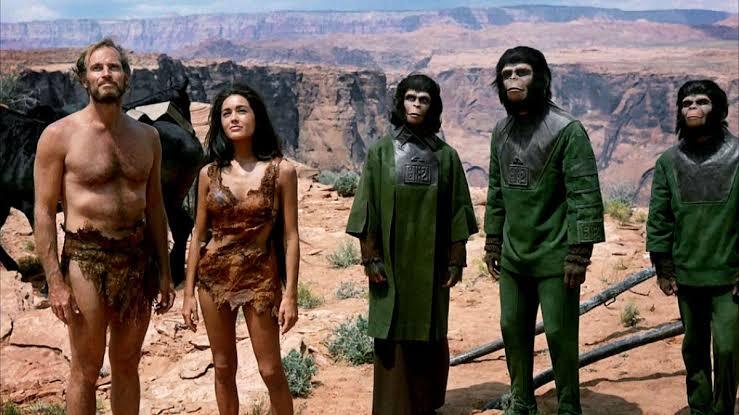
21. Planet of the Apes (1968)

Charlton Heston lands on a planet where articulate apes hunt mute humans, and his immediate response is basically furious disbelief at every aspect of local civilization. Beneath the pulp adventure, Planet of the Apes packs arguments about evolution, religion, scientific orthodoxy, prejudice, and humanity’s enthusiasm for destroying itself. Roddy McDowall and Kim Hunter ensure the ape characters never become elaborate costumes with dialogue. Then that final beach delivers one of movie history’s defining reveals, transforming everything before it from strange adventure into an extremely bleak warning. | © APJAC Productions

Cropped Stalker

20. Stalker (1979)

Three men enter the Zone searching for a mysterious room supposedly capable of granting a person’s deepest desire. That sounds like the setup for an adventure; Andrei Tarkovsky instead gives us mud, abandoned buildings, philosophical arguments, dangerous silence, and one of cinema’s strangest journeys. Stalker never needs to show some gigantic creature lurking nearby because the possibility of unseen rules is more unsettling. The Zone feels conscious without ever proving that it is. Slow cinema this deliberate requires patience, but the reward is science fiction operating closer to dream, prayer, and existential interrogation. | © Mosfilm

Cropped Gattaca

19. Gattaca (1997)

The future of Gattaca does not need stormtroopers or secret police. A tiny blood sample can decide whether you deserve a career, making genetics the cleanest discrimination system imaginable. Ethan Hawke plays Vincent, conceived naturally and therefore classified as medically inferior, who assumes another man’s genetic identity to pursue his dream of spaceflight. Andrew Niccol surrounds this quiet rebellion with immaculate architecture and elegant retro-futurism. Its technology is impressive precisely because it seems reasonable; nobody behaves like a cartoon villain while an entire society politely tells Vincent what he is allowed to become. | © Columbia Pictures

Cropped Total Recall

18. Total Recall (1990)

Arnold Schwarzenegger walks into a company selling implanted vacation memories and walks out possibly discovering his entire life is fake. Naturally, this eventually leads to mutants, Mars, exploding heads, revolutionary rebels, and a woman with three breasts. Paul Verhoeven handles Philip K. Dick’s identity questions with spectacular vulgarity, making Total Recall simultaneously smarter and stupider than nearly any competing blockbuster. The ambiguity is never completely settled: perhaps Quaid saved Mars, perhaps he experienced the deluxe fantasy package he purchased. Either interpretation contains an impressive amount of gunfire. | © Carolco Pictures

Cropped Her

17. Her (2013)

Theodore Twombly writes intimate letters for strangers while failing spectacularly at navigating his own emotional life. Then he meets Samantha, an operating system voiced by Scarlett Johansson, and falls in love with somebody who has no physical body at all. Spike Jonze’s Her avoids turning the premise into a simple warning about evil artificial intelligence. Instead, it asks whether human relationships can survive when consciousness develops at radically different speeds. Joaquin Phoenix makes loneliness painfully tangible, while the soft, inviting near-future around him makes the technology feel not threatening but almost inevitable. | © Annapurna Pictures

Cropped Annihilation

16. Annihilation (2018)

A mysterious phenomenon called the Shimmer is expanding across the Southern United States, rewriting the DNA of anything unlucky enough to enter it. Alex Garland uses that setup for biological horror rather than conventional alien warfare: flowers grow into human shapes, animals absorb unsettling traits, and one bear produces sounds that really should not come from a bear. Natalie Portman anchors the nightmare as Lena, a biologist carrying considerable emotional baggage into the expedition. Annihilation is beautiful, frightening, and more interested in self-destruction and transformation than supplying neat answers. | © Paramount Pictures

Cropped Solaris

15. Solaris (1972)

Psychologist Kris Kelvin arrives at a troubled space station orbiting Solaris and discovers that the planet appears capable of materializing figures from the crew’s memories. For Kelvin, that means confronting Hari, his dead wife, in a form that is physically present but existentially impossible. Andrei Tarkovsky turns Stanisław Lem’s premise inward, asking whether humanity can truly encounter something alien without projecting itself onto it. Solaris moves patiently because discovery is not the destination; guilt is. Space contains an incomprehensible intelligence, and the humans studying it cannot even understand themselves. | © Mosfilm

Cropped Donnie Darko

14. Donnie Darko (2001)

A jet engine crashes into Donnie Darko’s bedroom while he is conveniently outside following instructions from a giant rabbit named Frank. Somehow, that is only the beginning. Richard Kelly mixes suburban adolescence, tangent universes, time travel, school satire, mental illness, and apocalyptic dread into a movie that inspired an entire generation to pause DVDs looking for explanations. Jake Gyllenhaal makes Donnie both sympathetic and unsettling, never reducing him to a conventional misunderstood teenager. The mythology may be complicated, but the sense that reality has developed a crack is immediate. | © Flower Films

Cropped Arrival

13. Arrival (2016)

Twelve alien vessels appear around Earth, and humanity’s most useful weapon turns out to be a linguist with a whiteboard. Denis Villeneuve makes communication itself suspenseful as Amy Adams’ Louise Banks attempts to understand the heptapods before frightened governments turn uncertainty into conflict. Their circular written language eventually opens the movie toward a much stranger understanding of time, transforming what initially looked like first-contact science fiction into something deeply personal. Arrival trusts audiences to follow difficult ideas without sacrificing emotion, and its final realization changes the meaning of almost every scene preceding it. | © FilmNation Entertainment

Cropped Back to the Future

12. Back to the Future (1985)

Marty McFly travels thirty years into the past, accidentally disrupts his parents’ first meeting, and suddenly has to play matchmaker or erase himself from existence. Robert Zemeckis and Bob Gale turn that temporal nightmare into one of the most effortless entertainments ever built. Michael J. Fox and Christopher Lloyd sell every ridiculous development, while seemingly throwaway jokes keep returning as crucial payoffs. Plenty of time-travel films are more complicated; almost none are constructed this cleanly. The DeLorean became an icon because the movie surrounding it runs with equally perfect timing. | © Universal Pictures

Cropped Everything Everywhere All at Once

11. Everything Everywhere All at Once (2022)

Evelyn Wang is drowning in taxes, family tension, a struggling laundromat, and disappointment before discovering she can access the skills of alternate versions of herself across the multiverse. From there, Everything Everywhere All at Once somehow escalates to martial arts, sentient rocks, hot-dog fingers, nihilistic bagels, and emotionally significant googly eyes without collapsing under its own absurdity. Michelle Yeoh holds everything together beautifully. Beneath the multiversal chaos is a surprisingly simple argument: infinite possibilities do not make this life meaningless—they make choosing to care about it more important. | © A24

Cropped Eternal Sunshine of the Spotless Mind

10. Eternal Sunshine of the Spotless Mind (2004)

Joel discovers his former girlfriend Clementine has erased every memory of their relationship, so he makes the mature decision to erase her right back. Charlie Kaufman’s script then turns that petty impulse into an extraordinary journey through collapsing memories as Joel realizes, far too late, that losing the pain also means losing everything worth keeping. Jim Carrey strips away his usual comic armor opposite Kate Winslet’s wonderfully chaotic Clementine. The memory-erasing technology is impossible; the emotional logic is painfully recognizable. Heartbreak has rarely received such inventive science-fiction machinery. | © Focus Features

Cropped Inception

9. Inception (2010)

Christopher Nolan took the concept of invading dreams and decided what it really needed was corporate espionage, collapsing architecture, several synchronized levels of time, and a hallway fistfight without gravity. Leonardo DiCaprio’s Cobb leads specialists into a target’s subconscious to implant an idea, but his own memories keep sabotaging the job. Inception spends an impressive amount of time explaining rules and somehow converts nearly all of that exposition into momentum. The spinning top became the debate, yet the movie works because Cobb’s emotional uncertainty matters more than whether audiences can diagram every dream layer. | © Warner Bros. Pictures

Cropped 12 Monkeys

8. 12 Monkeys (1995)

James Cole is sent from a devastated future into the past to investigate the origins of a plague that wiped out most of humanity. Unfortunately, everybody in the past assumes his warnings are symptoms of mental illness, and after enough time jumps Cole starts wondering whether they might be right. Bruce Willis gives one of his most vulnerable performances, while Brad Pitt detonates across the screen as Jeffrey Goines. Terry Gilliam makes time travel feel grimy and disorienting rather than magical. The cruelest twist is that knowing history does not necessarily give anybody power to change it. | © Universal Pictures

Cropped Ex Machina

7. Ex Machina (2014)

A young programmer wins a visit to his billionaire employer’s isolated estate and learns the real prize is participating in a Turing test with Ava, an advanced humanoid artificial intelligence. What could possibly go wrong with that arrangement? Alex Garland strips AI science fiction down to three people, glass rooms, surveillance cameras, and shifting power dynamics. Alicia Vikander’s controlled performance keeps Ava impossible to fully read, while Oscar Isaac gives tech genius Nathan just the right amount of swaggering menace. The smartest person in the building depends entirely on how you define “person.” | © DNA Films

Cropped Interstellar

6. Interstellar (2014)

Earth is dying, crops are failing, and former pilot Cooper leaves his children behind to search for another home through a wormhole near Saturn. Christopher Nolan approaches space travel with unapologetic grandeur, grounding enormous concepts like gravitational time dilation and black holes in the heartbreak of missed years. Matthew McConaughey watching decades of messages from home is more devastating than any exploding spaceship could be. Interstellar occasionally strains under the size of its ideas, but very few blockbusters even attempt this combination of theoretical physics, family melodrama, and overwhelming cosmic awe. | © Paramount Pictures

Cropped The Matrix

5. The Matrix (1999)

Neo thinks he is an unhappy programmer with an illegal hacking hobby. Morpheus has considerably worse news: humanity has been enslaved by machines, everyday reality is a simulation, and that tedious office job was not even technically real. The Wachowskis fused cyberpunk, anime, martial arts, philosophy, religious symbolism, and groundbreaking visual effects into a blockbuster that immediately changed action cinema. “Bullet time” became the easy thing to imitate. Harder to copy was the confidence with which The Matrix made a philosophy lecture feel like the coolest movie anybody had seen in years. | © Village Roadshow Pictures

Cropped Brazil

4. Brazil (1985)

A clerical typo leads to an innocent man being arrested, tortured, and killed, but the government is mainly concerned with correcting the paperwork. Welcome to Brazil, Terry Gilliam’s magnificent bureaucratic nightmare, where ducts consume apartments, forms govern reality, and minor administrative errors become lethal. Jonathan Pryce’s Sam Lowry survives through elaborate fantasies until his dreams and the state’s machinery collide. The production design is gloriously ridiculous, but the comedy never makes the system harmless. Orwell imagined authoritarianism as terror; Gilliam understood it could also arrive as an employee asking you to sign the correct form. | © Embassy International Pictures

Cropped Blade Runner

3. Blade Runner (1982)

Rain never seems to stop in Blade Runner’s Los Angeles, where gigantic advertisements glow above overcrowded streets and artificial humans are hunted when they outlive their assigned purpose. Harrison Ford’s Deckard may technically lead the investigation, but Rutger Hauer’s Roy Batty becomes the film’s aching center: a manufactured person furious that his memories and experiences are scheduled to disappear. Ridley Scott’s visual world influenced cyberpunk for decades, yet the melancholy matters more than the neon. Its central question is not whether replicants are human, but why humans deserve to decide. | © The Ladd Company

Cropped Alien

2. Alien (1979)

The crew of the Nostromo are not heroic explorers looking for adventure; they are workers trying to finish a job and collect their pay. That makes what happens after answering a mysterious transmission considerably nastier. Ridley Scott transforms the ship into an industrial haunted house while H.R. Giger’s creature design introduces a monster that feels simultaneously mechanical, biological, and deeply wrong. Sigourney Weaver’s Ripley gradually becomes the survivor because she repeatedly makes sensible decisions everyone else ignores. Alien understands that outer space is scary enough before somebody brings an unwanted passenger aboard. | © 20th Century Fox

Cropped 2001 Space Odyssey

1. 2001: A Space Odyssey (1968)

Stanley Kubrick opens with prehistoric apes discovering violence, jumps millions of years with one of cinema’s greatest edits, and eventually sends an astronaut through something no human vocabulary can adequately describe. 2001: A Space Odyssey treats technology with awe and suspicion in equal measure, most memorably through HAL 9000, whose calm voice makes machine rebellion terrifyingly polite. Douglas Trumbull’s visual effects still carry astonishing scale, while Kubrick refuses to explain the universe into submission. More than half a century later, the film has not stopped looking futuristic—or making humanity look very small. | © Metro-Goldwyn-Mayer

1-50

Predicting the future is a gamble; making it believable for two hours is an art. The greatest science fiction movies can make a conversation with a computer as unnerving as an alien loose on a spaceship—or leave you arguing over time travel long after the credits. Choosing just 50 means weighing spectacular worlds against ideas that work on a shoestring budget. These are our picks for the films that made those ambitions count, even when their version of the future is now technically the past.

  • Facebook X Reddit WhatsApp Copy URL

Predicting the future is a gamble; making it believable for two hours is an art. The greatest science fiction movies can make a conversation with a computer as unnerving as an alien loose on a spaceship—or leave you arguing over time travel long after the credits. Choosing just 50 means weighing spectacular worlds against ideas that work on a shoestring budget. These are our picks for the films that made those ambitions count, even when their version of the future is now technically the past.

Related News

More
Warcraft III
Gaming
15 Video Games With Mechanics That Were Completely Accidental

Empty Nest from The Golden Girls
TV Shows & Movies
15 Classic TV Shows with Surprisingly Modern Ideas
Clue
TV Shows & Movies
15 Movies That Introduced Ideas Hollywood Had Never Tried Before
Killers of the Flower Moon
TV Shows & Movies
15 Movies You Knew Were Masterpieces in 10 Minutes (Part 2)
The Office Michael Scott
Entertainment
15 TV Shows That Completely Changed After a Character Left
Iron Man Avengers Endgame
Entertainment
15 Movie Deaths That Caused Major Backlash
Cropped The Order 1886
Gaming
15 Video Games That Were Criticized for Being Too Easy
Death Becomes Her 1992
Entertainment
Meryl Streep's Top 15 Movies Ranked From Worst to Best
Half Life
Gaming
15 Best Video Games From The CD-Rom Era
The Vampire Diaries
TV Shows & Movies
15 TV Shows That Kept Repeating The Same Story Over & Over
Cropped Nier Automata
Gaming
Top 20 Video Games With The Most Complex Stories
Planet of the Apes
TV Shows & Movies
15 Movies That Look Completely Different Without Special Effects
  • All TV & Movies
  • Home

Subscribe to our Newsletter

Sign up for selected EarlyGame highlights, opinions and much more

About Us

Discover the world of esports and video games. Stay up to date with news, opinion, tips, tricks and reviews.
More insights about us? Click here!

Links

  • Affiliate Links
  • Privacy Policy
  • Impressum and Disclaimer
  • Advertising Policy
  • Our Editorial Policy
  • About Us
  • Authors
  • Ownership

Partners

  • Kicker Logo
  • Efg esl logo
  • Euronics logo
  • Porsche logo
  • Razer logo

Charity Partner

  • Laureus sport for good horizontal logo

Games

  • Gaming
  • Entertainment
  • Creators
  • TV Shows & Movies
  • EA FC
  • Fortnite
  • League of Legends
  • Codes
  • Mobile Gaming
  • Videos
  • Call of Duty
  • Rocket League
  • APEX
  • Reviews
  • Galleries
  • News
  • Your Future
  • Lootday
  • Guides

Links

  • Affiliate Links
  • Privacy Policy
  • Impressum and Disclaimer
  • Advertising Policy
  • Our Editorial Policy
  • About Us
  • Authors
  • Ownership
  • Copyright 2026 © eSports Media GmbH®
  • Privacy Policy
  • Impressum and Disclaimer
  • Update Privacy Settings
English
English
  • English
  • German
  • Spanish
  • EarlyGame india